

Mechanisms, clinical evidence, safety and research priorities
Initiation, direction and supervision: Tibi Moravcik
Research and analysis: AI-assisted
Benefits_of_Decompression_Therapy_ElasticPravilo_Final.pdf
Combined evidence review
Prepared from the two supplied analyses, merged and de-duplicated. Mechanistic claims, clinical evidence, safety considerations and device-specific limitations are kept distinct.
Executive summary
Decompression therapy is not a single standardised intervention. It includes motorised spinal traction, manual traction, suspension-based unloading, inversion, joint distraction and surgical decompression. Evidence therefore depends on the body region, force profile, treatment dose and patient group.
The mechanical rationale is credible. Unloading can reduce axial compression and intradiscal pressure, temporarily alter disc height, enlarge some neural foraminal dimensions, and change the mechanical state of muscles, ligaments and other connective tissues.
The clinical evidence is much less uniform. The strongest reviews find little or no meaningful benefit for average nonspecific low back pain. More targeted studies in people with disc herniation or radiculopathy report modest short-term improvements, especially when traction is added to active physiotherapy. Long-term evidence remains limited.
A scientifically careful analysis therefore needs to distinguish what has been demonstrated mechanically from what has been demonstrated clinically. It should also avoid transferring results from motorised traction devices to elastic or suspension systems without direct evidence.
1. What decompression actually does mechanically
Traction applies a tensile force along the axis of a body segment. In the spine, this can produce several measurable mechanical effects:
- reduced compressive loading during treatment
- temporary separation or altered orientation of adjacent vertebrae
- changes in intervertebral disc height
- changes in the dimensions of the neural foramina
- changes in the mechanical state of muscles, ligaments and facet joints
- movement and redistribution of fluid within viscoelastic tissues
The key scientific point is that these are immediate or short-term mechanical effects. They should not be presented as proof of permanent structural correction.
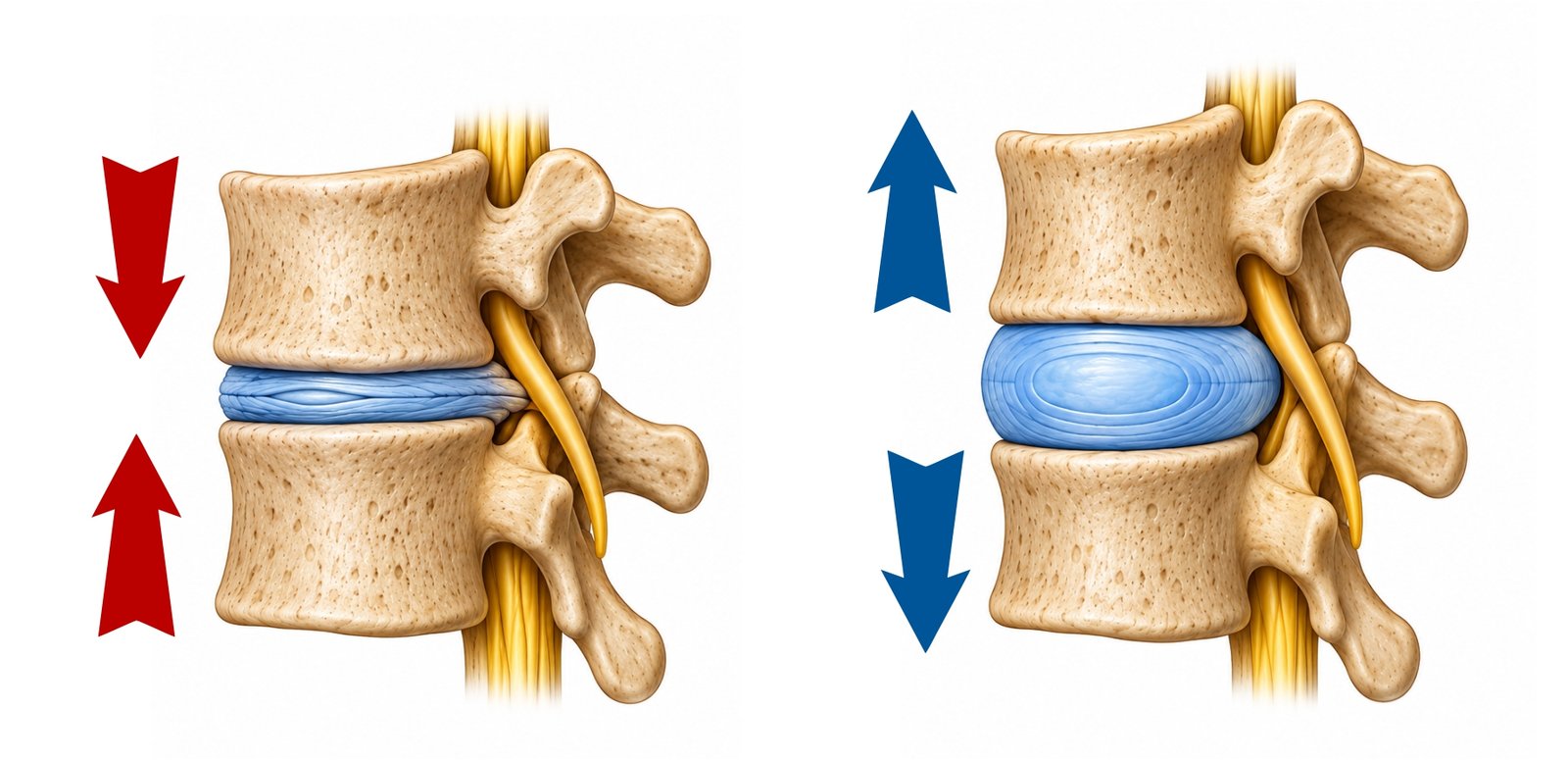
Visual explanation: spinal compression and unloading
Illustration of spinal loading and unloading. The image illustrates the mechanical concept and is not, by itself, evidence of clinical benefit.
Watch: Disc decompression in motion
The illustration shows the basic mechanical idea of moving from axial compression towards unloading. The linked video is a visual demonstration, not a clinical trial or proof that the same anatomical change occurs to the same degree in every treatment.
2. Intradiscal pressure and disc nutrition
Foundational work by Alf Nachemson showed that lumbar intradiscal pressure changes substantially with posture and loading. Classic measurements reported higher loading in unsupported sitting and flexed loading, with much lower pressures in supine or reclined positions. A later in vivo re-measurement using modern transducers broadly confirmed the importance of posture and movement while questioning some of the classic numerical relationships.
Traction extends the unloading principle: tensile distraction can reduce intradiscal pressure during the intervention. Because the intervertebral disc is largely avascular and depends heavily on diffusion through the endplate and peripheral tissues, unloading may alter fluid and solute transport. The defensible formulation is therefore that mechanical unloading may improve the disc’s fluid-transport environment. It is not accurate to say that decompression simply “increases blood flow into the disc”.
A further honesty check is important: intradiscal-pressure measurements describe mechanical loading, not the source of a person’s pain. Even if a particular posture raises pressure, that does not establish that the disc is the pain generator.
3. Disc height, spinal geometry and foraminal widening
Imaging studies provide some of the clearest evidence that traction changes spinal geometry temporarily.
A lumbar MRI study found a significant increase in disc height after 30 minutes of traction at 42% of body weight, with the strongest effects in the lower lumbar discs and a larger posterior change. In the cervical spine, in vivo imaging studies have shown increases in foraminal height and area with traction.
The practical interpretation is cautious: more anatomical space can reduce mechanical constraint on sensitive structures, but anatomical change does not automatically produce meaningful pain relief. The relationship among anatomy, inflammation, nerve sensitivity and pain is more complex than “more space = less pain”.
4. Possible reduction of nerve-root irritation
A spinal nerve root may be affected by reduced foraminal space, disc protrusion or extrusion, osteophytes, facet changes, ligamentous thickening and local inflammation. Traction can enlarge foraminal dimensions and alter the mechanical environment around the exiting nerve.
This provides a plausible explanation for why a subgroup of patients with radicular symptoms may respond better to traction than people with nonspecific low back pain. A systematic review and meta-analysis found short-term improvements in pain and disability when supine mechanical traction was added to physiotherapy for lumbar radiculopathy, although favourable findings were driven largely by lower-quality studies.
An older randomised trial also suggested that patients with leg symptoms and clinical signs of nerve-root compression may be a more responsive subgroup. The observed benefit was greater at two weeks and was not maintained at six weeks.
5. Why traction may reduce pain without permanently changing anatomy
Pain is not a direct read-out of mechanical compression. Mechanical input from discs, joints, muscles and nerves is processed by peripheral and central nervous systems. Changing loading can therefore alter sensory input and movement behaviour without a large structural change.
- altered nociceptive input
- reduced protective muscle activity or guarding
- greater tolerance of movement
- changes in perceived threat and movement confidence
- contextual effects such as expectation, attention, breathing and relaxation
A strong subjective improvement is therefore not evidence by itself that a disc has been repositioned. Conversely, the absence of a large structural change does not mean that the person’s symptom relief is imaginary. The mechanisms can be both mechanical and neurophysiological.
6. Myofascial and connective-tissue effects
The older idea that fascia simply “melts” from gel to sol under manual pressure is not a satisfactory modern explanation. The forces and durations required to produce permanent mechanical deformation of collagenous tissues are generally much larger than those delivered by an ordinary manual-therapy or traction session.
More defensible mechanisms include mechanosensory input and short-term viscoelastic behaviour. Fascia and associated connective tissues contain mechanoreceptors, and sustained pressure or stretch can influence sensory processing and muscle guarding. Viscoelastic creep is also real: tissue length changes under sustained load and can remain partially altered for a period afterwards.
These mechanisms provide a plausible explanation for the feeling of “release” after treatment, but they do not justify claims that a single session permanently restructures fascia or collagen.
7. Autonomic nervous system effects
Passive stretching and traction-like input have been associated in some controlled studies with changes in heart-rate variability consistent with increased parasympathetic influence. This is an interesting mechanism because a decompression session can combine mechanical loading with sustained, supported relaxation.
However, the evidence specific to spinal decompression is limited. Most of the relevant literature concerns passive stretching, massage or other forms of mechanical input. Autonomic effects should therefore be described as plausible and consistent with related research, not as established consequences of spinal decompression.
8. Temporary increase in movement
Low back pain is commonly associated with altered movement and reduced willingness to load or move through certain ranges. Traction may temporarily make movement feel easier by changing mechanical constraints and sensory input.
The useful outcome is not simply a larger range measured on a table. Increased movement is most valuable when it allows a person to walk, exercise, perform daily activities and participate more fully in active rehabilitation. Decompression should therefore be considered a possible facilitator of movement rather than a substitute for movement.
9. Does decompression pull a herniated disc back into place?
Evidence does not establish that ordinary traction reliably “sucks” a slipped or herniated disc back into position. There is a different, well-established phenomenon: herniated discs can regress spontaneously during conservative management.
Meta-analyses have reported much higher spontaneous regression rates for extruded and sequestered discs than for simple bulges. Consequently, when an MRI improves after a period of traction, a controlled trial is needed before attributing the anatomical regression specifically to traction.
10. Joint unloading: a separate but informative evidence base
The strongest evidence that prolonged mechanical unloading can produce structural biological changes comes from knee joint distraction, not from ordinary spinal traction. Surgical knee distraction temporarily separates joint surfaces for several weeks, and studies have reported improvements in pain and function together with changes in joint space and cartilage measures.
Proposed mechanisms include partial unloading, oscillations in synovial-fluid pressure, changes in subchondral bone, molecular changes and cellular responses associated with cartilage repair. This is scientifically interesting because it demonstrates that mechanical loading can influence tissue biology.
It should not, however, be used to claim that a short spinal decompression session regenerates cartilage or spinal discs. The duration, magnitude and tissue environment are fundamentally different.
11. What the clinical trial evidence actually shows
This is the most important counterweight to attractive mechanistic explanations.
11.1 Nonspecific low back pain
The highest-quality evidence is generally unfavourable. The Cochrane review of traction covers 32 randomised trials and roughly 2,750 participants and concludes that traction makes little or no meaningful difference to pain, function or return to work compared with sham traction, placebo or no treatment in people with or without sciatica. A later overview of non-surgical low back pain evidence also remains cautious.
NICE therefore recommends not offering traction for the routine management of low back pain with or without sciatica.
11.2 Lumbar radiculopathy and disc herniation
More recent and narrower studies are more favourable when the population is defined by disc herniation or radiculopathy rather than nonspecific back pain. Several 2019-2024 reviews and trials report short-term improvements in pain and disability when traction or decompression is added to conventional physiotherapy.
- A 2022 meta-analysis of mechanical traction for disc herniation reported statistically significant reductions in VAS pain and ODI disability versus physiotherapy alone.
- A 2024 randomised trial comparing motorised traction and non-surgical decompression, added to conventional physiotherapy, reported better outcomes than conventional treatment alone for subacute and chronic discopathy.
- A retrospective cohort study reported that the degree of disc-height restoration on CT after non-surgical decompression correlated with pain reduction. This is interesting but observational and cannot establish causation.
- A 2024 meta-analysis of suspension-based exercise, a related actively engaged form of traction, reported favourable pooled results for disc herniation.
The caveat is critical. Some positive device studies are small, difficult to blind and sometimes industry-connected. Because participants can feel when a mechanical device is pulling, sham control is inherently difficult. One sham-controlled trial of vertebral axial decompression found no benefit over sham.
11.3 Cervical radiculopathy
Some systematic reviews report benefit when cervical traction is added to physiotherapy, while others find that the average pain effect is small and not clinically meaningful. Evidence quality is low or mixed. The reasonable conclusion is that cervical traction may help some patients with radicular symptoms, but broad claims for chronic neck pain are not justified by the evidence.
12. Scientific hierarchy of claims
|
Claim |
Evidence status |
Careful wording |
|---|---|---|
|
Temporary reduction of axial loading |
Strong biomechanical plausibility |
Unloading reduces compressive loading during treatment. |
|
Temporary increase in disc height |
Demonstrated experimentally |
Traction can temporarily increase disc height in some spinal segments. |
|
Increase in some foraminal dimensions |
Demonstrated experimentally |
Traction can enlarge some neural foraminal dimensions. |
|
Reduction of pain in selected radicular conditions |
Moderate but inconsistent |
May help selected patients, especially as an adjunct to rehabilitation. |
|
General treatment for nonspecific low back pain |
Weak/negative |
Routine traction is not supported by high-quality evidence. |
|
Permanent spinal decompression |
Not established |
Do not imply a lasting increase in spinal space. |
|
Putting discs back into place |
Not established |
Do not claim reliable mechanical repositioning. |
|
Increasing blood flow into discs |
Incorrect formulation |
The disc is largely avascular; use fluid transport/diffusion language instead. |
|
Improving disc nutrition |
Plausible mechanism, clinical effect unproven |
Unloading may alter fluid and solute transport. |
|
Fascial release |
Plausible short-term mechanism |
Mechanosensory and viscoelastic effects are more defensible than “fascia melting”. |
|
Parasympathetic shift |
Plausible, limited direct evidence |
Related stretching literature supports the possibility, not proof for decompression. |
|
Cartilage regeneration from joint distraction |
Promising, condition-specific evidence |
Evidence mainly concerns prolonged surgical knee distraction. |
|
General systemic health benefits |
Insufficient evidence |
Avoid broad claims without direct trials. |
13. A scientifically defensible model
- Mechanical unloading changes tissue deformation and joint loading.
- This can temporarily alter disc height and/or joint spacing.
- The changed mechanical environment may reduce irritation of sensitive structures.
- Sensory input and movement behaviour can also change.
- In selected individuals, this may reduce pain and improve movement tolerance.
- The treatment can therefore create a window in which active rehabilitation and normal movement become easier.
14. ElasticPravilo and the concept of Elastic Decompression
Nearly all clinical trials discussed above concern motorised mechanical traction, manual traction or gravity/inversion approaches. The available evidence does not establish the clinical effectiveness of ElasticPravilo specifically. The concept of Elastic Decompression therefore needs to be presented as a promising mechanical approach that still requires direct clinical research.
Elastic Decompression: a gentle, adaptable and self-regulated approach
ElasticPravilo uses elastic elements to create a progressive tensile force that can be adjusted through body position, movement and range. This offers a potentially gentler alternative to fixed-force traction, while allowing the practitioner or user to regulate the load and combine decompression with active movement, breathing and conscious Expansion.
ElasticPravilo differs from many motorised systems because elastic elements can provide progressively increasing resistance and allow the user to regulate the amount of tension through position, movement and range. This may support a particularly gentle form of decompression in which loading can be introduced gradually rather than abruptly. That is a biomechanical rationale and a potential practical advantage, not yet a clinically proven superiority.
The safety and gentleness of Elastic Decompression depend on the elastic properties, attachment points, body position, maximum available force, equipment condition, instruction and the individual user. Its most promising feature may be the combination of decompression with active participation: the person can soften, expand, breathe, move and explore the direction and amount of tension instead of being passively pulled by a fixed machine. This makes ElasticPravilo especially relevant to a broader concept of conscious, self-regulated decompression.
For ElasticPravilo, the central proposition is therefore not that elastic traction has already been proven to cure a particular condition. It is that elastic resistance offers a potentially gentle, adaptable and self-regulated way of applying decompressive forces while combining mechanical unloading with movement and body awareness.
There is indirect supporting evidence for the use of elastic resistance and sling-based exercise in rehabilitation, but these studies are not trials of ElasticPravilo and should not be presented as device-specific evidence. For example, a randomised trial found beneficial effects from sling exercise using elastic bands in people with chronic low back pain and clinical spinal instability, while another trial compared progressive resistance-band training with general exercise in multidisciplinary rehabilitation. These findings support the broader usefulness of elastic loading and active exercise, not the specific efficacy of ElasticPravilo. [See Further Research.]
15. Mental and emotional decompression
Body posture and emotional state can influence one another. Controlled studies have found that adopting a more upright posture can affect mood, affect, fatigue, self-focus and some responses to psychological stress. For example, a randomised study in people with depressive symptoms found that upright posture increased positive affect and reduced some negative outcomes during a brief stress task. Another controlled study found that upright versus slumped walking was associated with differences in psychological and physiological responses to a stressor. These findings support a body-emotion relationship, but they do not establish decompression itself as a treatment for depression, anxiety or other mental disorders.
Pravilo resources: Mental Aspects | Mind and Emotions | Stress releasing
More recent research supports the existence of a body-emotion relationship but also shows that the effect is not simple or universal. A 2025 systematic review and meta-analysis found heterogeneous relationships between emotional stimuli and postural responses, while a 2026 study reported that the effect of posture on emotional recovery varied according to individual differences in embodied experience. The scientifically defensible conclusion is therefore that posture can influence emotional and cognitive processes in some contexts, while emotions and mental states can also influence posture.
For decompression, this creates a plausible pathway beyond local mechanical effects. A more open, less guarded and more comfortable body position may change breathing, movement, attention, self-perception and responses to stress. This is consistent with the broader Pravilo concept of Expansion: consciously moving from a closed or protective state towards a more open and relaxed state. The available posture research supports the body-emotion connection, but it does not establish that decompression itself treats depression, anxiety or trauma.
The Pravilo perspective also places conscious Expansion alongside mechanical decompression. Practitioners report that an expanded and relaxed state can feel calmer, more open, curious and easier to move through. These are appropriate as reported experiences or hypotheses until they are tested directly in controlled research.
16. Safety and contraindications
Traction-type interventions are commonly excluded or used cautiously in conditions where distraction could be unsafe or where urgent medical assessment is required. The supplied evidence review identifies:
- osteoporosis or significantly compromised bone density
- spinal fracture, instability or clinically significant spondylolisthesis
- active spinal infection, tumour or metastatic disease
- cauda equina syndrome or progressive neurological deficit
- pregnancy
- rheumatoid arthritis or other inflammatory spinal disease
- uncontrolled cardiovascular disease, aortic aneurysm or thrombosis near the treatment area
- recent spinal surgery
This list is not a substitute for clinical screening. Red-flag neurological symptoms, suspected infection, malignancy, fracture or vascular disease require appropriate medical assessment rather than self-directed decompression.
17. Priority research questions
- Does decompression change spinal geometry? Measure intervertebral height, foraminal area and spinal curvature before, during and after treatment.
- How long do these effects persist? Measure immediately, 30 minutes, 2 hours, 24 hours and longer follow-up intervals.
- Does force magnitude matter? Compare low, moderate and high tensile loads.
- Does oscillatory traction differ from static traction?
- Does complete relaxation produce a different effect from active resistance or self-generated counterforce?
- Which clinical subgroup responds best? Compare nonspecific low back pain, radiculopathy, disc herniation, spinal stenosis and healthy participants.
- Is the effect primarily mechanical, neurological, or both? Combine imaging, EMG and sensory testing with pain and function measures.
- Does treatment change what people can do afterwards? Functional outcomes may be more clinically meaningful than a transient change in spinal geometry.
A particularly useful experimental programme for a suspension apparatus would combine MRI or ultrasound, motion capture, EMG, force sensors, range-of-motion measurements, quantitative sensory testing and longitudinal patient-reported pain and function outcomes.
18. Reported feelings and user experience
Reported experiences associated with Pravilo and related expansion practices include relief, relaxation, a feeling of a stronger or more elastic body, greater lightness or fluidity of movement, and improved ability to cope with stress. These reports are important because they describe the lived experience of the method and can generate hypotheses for formal research.
So far, the upgraded ElasticPravilo approach has not been directly researched in controlled clinical trials. This absence of evidence is not evidence of absence of benefit, but it means that superiority, safety margins and clinical effectiveness should be tested rather than assumed. The gentleness and self-regulated nature of the elastic approach are best presented as design and practice characteristics, with potential advantages that warrant investigation.
19. Types of decompression
Decompression can be understood as occurring through both externally applied mechanical forces and consciously directed changes in movement, attention and bodily organisation.
19.1 Mechanically
- Suspension, Pravilo, inversion table, motorised mechanical traction, aerial yoga and ElasticPravilo / Elastic Decompression
- Manual traction by a therapist
- Massage and myofascial release
19.2 Consciously
- Expansion, patterns and images
- Applications that direct attention, breathing or body awareness towards expansion
- Meditations, games and exercise
The distinction is useful because decompression does not have to be produced only by an external pulling force. Mechanical methods change physical loading directly, while conscious methods aim to change how a person organises posture, breathing, attention, movement and perceived expansion. ElasticPravilo can combine both dimensions: an external elastic force with active, conscious regulation by the practitioner.
20. Related aspect: flow and fluid movement
A related aspect is flow and fluid movement. In the Pravilo concept, an expanded and relaxed body is experienced as more fluid, with less unnecessary resistance to movement. Elastic Decompression may support this quality by allowing movement while gentle tensile force assists expansion and changes how loads are distributed through the body. In biomechanical terms, related concepts that can be tested include coordination, movement efficiency, force distribution and mechanical energy transfer.
The phrase “flow of kinetic energy” is useful as a description of movement experience, but it should not be presented as an established physiological variable. Kinetic energy is measurable, while feeling that movement is flowing, light, smooth or efficient is a broader perceptual and motor phenomenon. The Pravilo concept also refers to blood, lymph, breathing and other forms of flow. These are distinct physiological processes that require separate measurement rather than being assumed from the word “flow”.
Pravilo resource: Fluid being & Flow
Decompression may improve conditions for movement and local fluid exchange in affected tissues. Research should test whether ElasticPravilo produces measurable changes in range of motion, movement variability, force distribution, EMG activity, balance, circulation-related measures and subjective movement quality. These outcomes would provide a bridge between the language of “flow” used by practitioners and measurable physiological or biomechanical variables.
21. Further research, videos and animations
Featured ElasticPravilo resource: ElasticPravilo / Elastic Decompression
Video: Disc decompression in motion
Pravilo conceptual resources
Mental and emotional framework used by the Pravilo system. Pravilo: Mental Aspects
Pravilo discussion of body opening, posture, emotion and thought. Pravilo: Mind and Emotions
Pravilo approach to Expansion, relaxation, breathing and stress. Pravilo: Stress releasing
Pravilo conceptual framework for fluid movement and kinetic energy flow. Pravilo: Fluid being & Flow
ElasticPravilo and Elastic Decompression
Requested Pravilo resource – concept, practice and development of the elastic approach. ElasticPravilo / Elastic Decompression
Pravilo material on elastic-band expansion and related movement concepts. Pravilo: Expand by Elastic Band
Recent Pravilo overview linking suspension, decompression, body awareness, flow and elastic tensegrity. Pravilo: How Does Profound Expansion Enhance Wellness?
Indirect evidence only – elastic resistance plus active exercise, not ElasticPravilo. PubMed: Sling exercise with elastic bands for chronic low back pain
Indirect evidence only – elastic resistance training, not decompression. PubMed: Resistance-band training in multidisciplinary low back pain rehabilitation
Clinical evidence
Cochrane: Traction for low back pain – Core systematic review and plain-language summary.
NICE guideline NG59: Low back pain and sciatica – UK clinical recommendation on traction.
Mechanical traction for lumbar radiculopathy – systematic review/meta-analysis – Short-term effects when added to physiotherapy.
Vertical traction for lumbar radiculopathy – systematic review – Useful for understanding evidence quality and uncertainty.
Suspension exercise training for disc herniation – 2024 meta-analysis – Related evidence for actively engaged suspension exercise.
Biomechanics and foundational studies
Wilke et al. – in-vivo intradiscal pressure re-measurement – Important modern reassessment of posture and disc pressure.
Lumbar traction and disc height – MRI study – Direct imaging evidence of short-term disc-height change.
Cervical traction and foraminal dimensions – In-vivo imaging of foraminal changes.
Intervertebral disc nutrition and nutrient transport – Background on disc physiology and diffusion.
Intervertebral disc pressures during traction – Foundational traction-pressure evidence.
Knee joint distraction systematic review – Separate evidence base for prolonged joint unloading.
Mechanisms of joint distraction – Biological mechanisms proposed for tissue response to unloading.
Fascia, connective tissue and autonomic mechanisms
Fascial plasticity: a neurobiological explanation – Useful corrective perspective on older “fascia melts” models.
2026 Frontiers review on mechanistic effects of myofascial input – Related mechanistic evidence; not decompression-specific.
ClinicalTrials.gov: NCT07197047 – Trial relevant to static neck stretching, tissue stiffness and autonomic mechanisms.
Posture, emotion and mental health
Randomised trial: upright versus slumped posture during a stress task. PubMed: Upright posture and stress responses
Randomised study of people with mild-to-moderate depressive symptoms. PubMed: Upright posture, affect and fatigue in depressive symptoms
Experimental study linking posture with emotional and cognitive measures. PubMed: Upright versus stooped posture, interpretation bias and emotions
Shows that body-emotion posture effects are heterogeneous and context dependent. PubMed: 2025 systematic review and meta-analysis of emotional stimuli and body posture
Shows that posture effects on mood recovery may depend on embodied experience. PubMed: 2026 study of posture and emotion regulation
Anatomy, diagrams and video
AAOS: Anatomy of the spine animation – Useful anatomy overview with animation.
MedlinePlus: Herniated disk – Patient-level anatomy and animation.
Spinal decompression – 3D animation – Useful visualisation; therapeutic claims should be treated critically.
Wikipedia: Intervertebral disc – Basic anatomical reference.
Wikipedia: Disc herniation – Basic overview of herniation.
22. One-paragraph summary for book or website copy
Decompression can be understood as a mechanical unloading intervention with possible effects that extend beyond local mechanics into movement, body awareness and, potentially, emotional state. The best-supported effects in spinal traction research are temporary reductions in loading, altered intradiscal pressure, temporary changes in disc height and enlargement of some neural foraminal dimensions. These changes provide plausible mechanisms for reducing mechanical irritation and making movement easier in selected people, especially some patients with disc herniation or radiculopathy. ElasticPravilo adds a distinct concept: gentle, adaptable and self-regulated elastic decompression that combines external tensile force with active movement, breathing and conscious Expansion. This is a promising hypothesis rather than a clinically established superiority, because ElasticPravilo itself has not yet been directly tested in controlled trials. Posture research supports a bidirectional relationship between bodily posture and emotional or cognitive processes, but it does not establish decompression as a treatment for mental illness. Reported feelings of relief, lightness, greater elasticity, stronger movement and improved stress coping are valuable observations that should be tested systematically. Long-term evidence across decompression approaches remains limited.
Evidence note: This document combines the supplied evidence review with the previous analysis and additional web-verified sources from Pravilo and peer-reviewed research. It distinguishes direct clinical evidence from mechanistic plausibility, indirect evidence, practitioner reports and conceptual language. The ElasticPravilo-specific evidence base remains undeveloped, so device-specific clinical claims are intentionally conservative.
